Welcome to 
Innovation Initiatives in Biosciences Biotechnology and Bioeconomy (In2Bio3)


At In2Bio3, we conduct innovative research and translate the outcomes into practical values and impactful solutions that are beneficial to society. In addition, we educate and train students and the next generation of scientists, preparing them to address global challenges in health, food, and environment. 


Join us as we build a better future through innovative sciences.

About In2Bio3

In2Bio3 is a non-profit research and education organization (Yayasan Penelitian dan Pendidikan) established on the 7th of January 2026 through Decree of the Minister of Law of the Republic of Indonesia Number AHU-0000481.AH.01.04.Tahun 2026. Its administration office is located in South Tangerang, Indonesia. Approximately 18 scientists with diverse educational backgrounds and areas of scientific expertise are currently affiliated with In2Bio3, creating an interdisciplinary collaborative environment to tackle complex issues in public health, environmental sustainability, and sustainable economy.


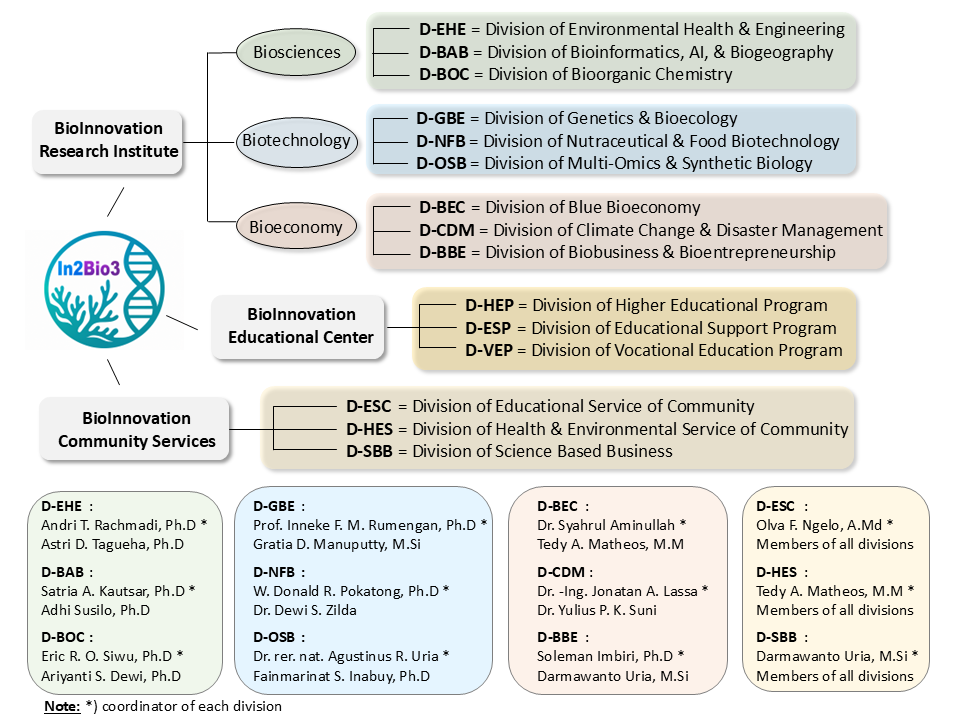
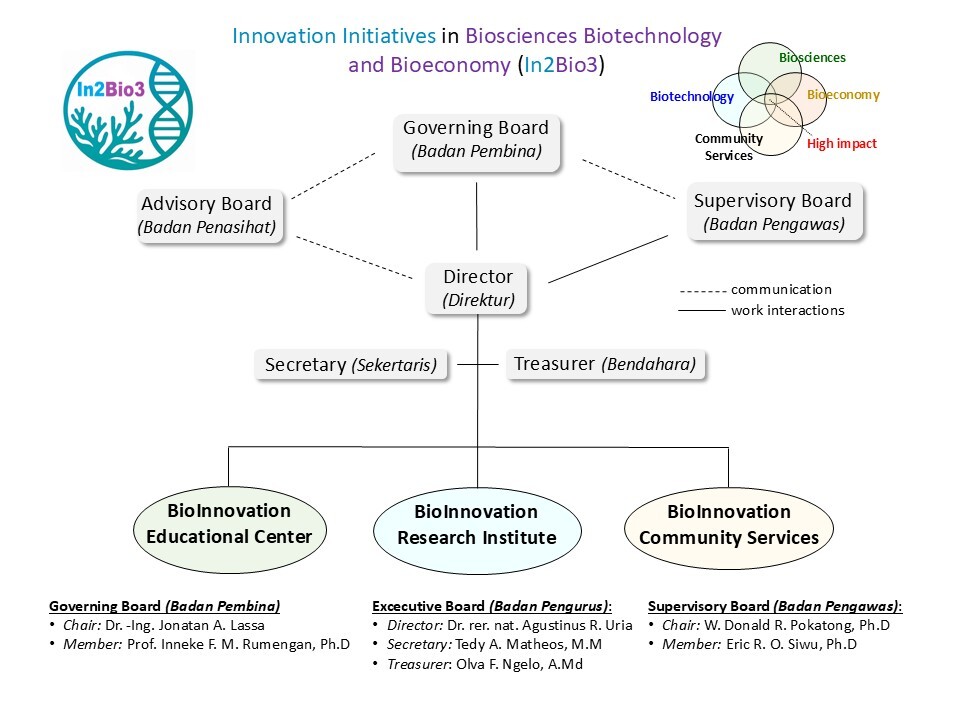
The activities or programs of In2Bio3 are organized into three components: (1) research programs implemented through The BioInnovation Research Institute as the main element; (2) education & educational support programs administered by The BioInnovation Educational Center as a supporting element; and (3) community development & service programs delivered through The BioInnovation Community Services as an additional supporting element. Furthermore, The BioInnovation Research Institute of In2Bio3 is duly registered as a non-profit research institution at Indonesian National Research and Innovation Agency (BRIN) under the registration code of C02604210.

Organizational Structure of In2Bio3

The In2Bio3 Vision & Mission

Our strategic vision is to become locally impactful and internationally respected hubs in Biosciences, Biotechnology, and Bioeconomy (Bio3), contributing to public health improvement as well as promoting sustainable economy and environmental sustainability. Towards achieving the vision, we set our mission:

1. The BioInnovation Research Institute: To conduct innovative research in Biosciences, Biotechnology, and Bioeconomy (Bio3) and translate research findings or results into practical solutions for improving public health, environment and socio-economy of the society.

2. The BioInnovation Educational Center: (i) To contribute to enhancing the quality of education and research in Indonesia by providing mentorship, guidance, and innovative learning environments for students and young generation; and (ii) To establish and operate an inclusive educational and research institute as a center of excellence in biosciences, biotechnology, and bioeconomy.

3. The BioInnovation Community Services: To apply Bio3 knowledge in community services and development, such as environmental protection, biodiversity conservation, genetic-based diagnosis of diseases and pathogens, disaster mitigation education, and food-water quality testing.
3

Research Projects

3

Community Services

7

Partnerships

27

Students Mentored

Our Core Values

Bioinnovation

We strive to cultivate a culture of creativity and ingenuity in Biosciences, Biotechnology, and Bioeconomy

Collaboration

We believe in the power of partnerships to drive impactful research and translate the outcome for the benefits of the society

Community Impact

We are committed to applying our scientific knowledge for the betterment of society and the environment.

Our Services in Scientific Research

Innovative Research Initiatives

Education & Mentorship Programs

Research Institute Development

Community Engagement Activities

Environmental Conservation Projects

Healthcare Improvement Solutions

In2Bio3 Approaches in Research, Education, and Community Services

In Biosciences and Biotechnology, we investigate biodiversity and ecological processes in unique ecosystems. We conduct interdisciplinary research to explore the potential of marine and terrestrial bioresources for generating various valuable bioproducts (e.g. pharmaceuticals, nutraceuticals, and biopesticides), and subsequently develop innovative approaches for applications that support health, food security, and environmental resilience. In Bioeconomy, we promote and support sustainable economic opportunities of the society, such as sustainable fisheries, ecotourism, aquaculture, and bioproduct innovation, which balance high productivity and climate change mitigation. We integrate local wisdom with scientific research and policy advocacy to contribute to community engagement & development, and biodiversity conservation. 

Core Scientists/Staffs

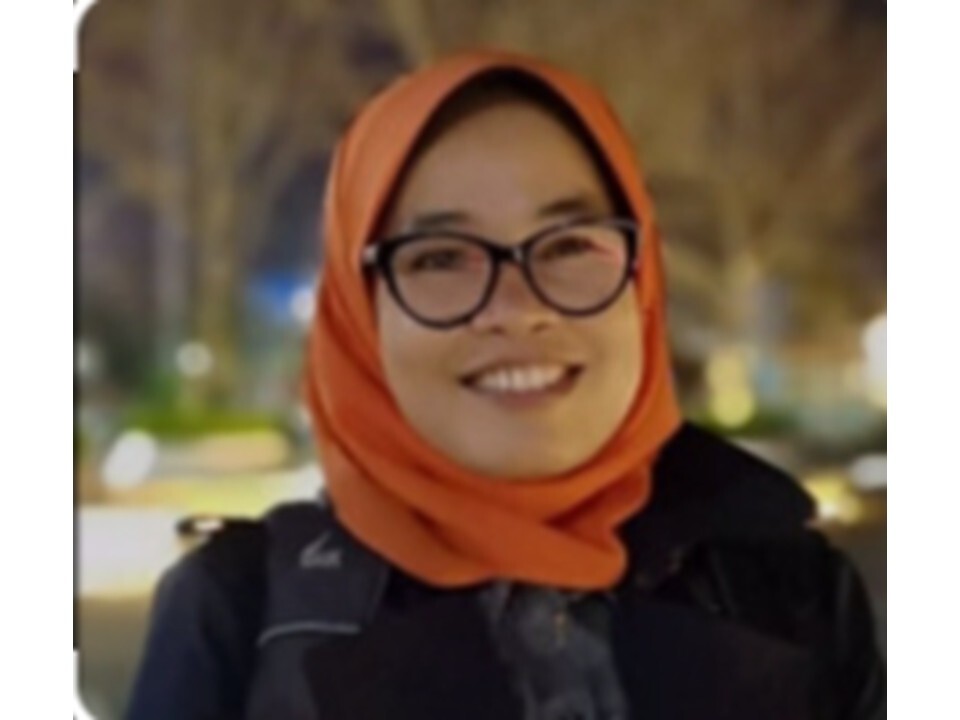
Dr. rer. nat. Agustinus R. Uria

In2Bio3 Principal Scientist

Multi-Omics & Synthetic Biology

Former Assistant Professor at 

Hokkaido University, Japan (2020-2025)

Doctor in Biology - Microbiology, The University of Bonn, Germany (2012)

Agustinus Robert Uria‬ - ‪Google Scholar‬

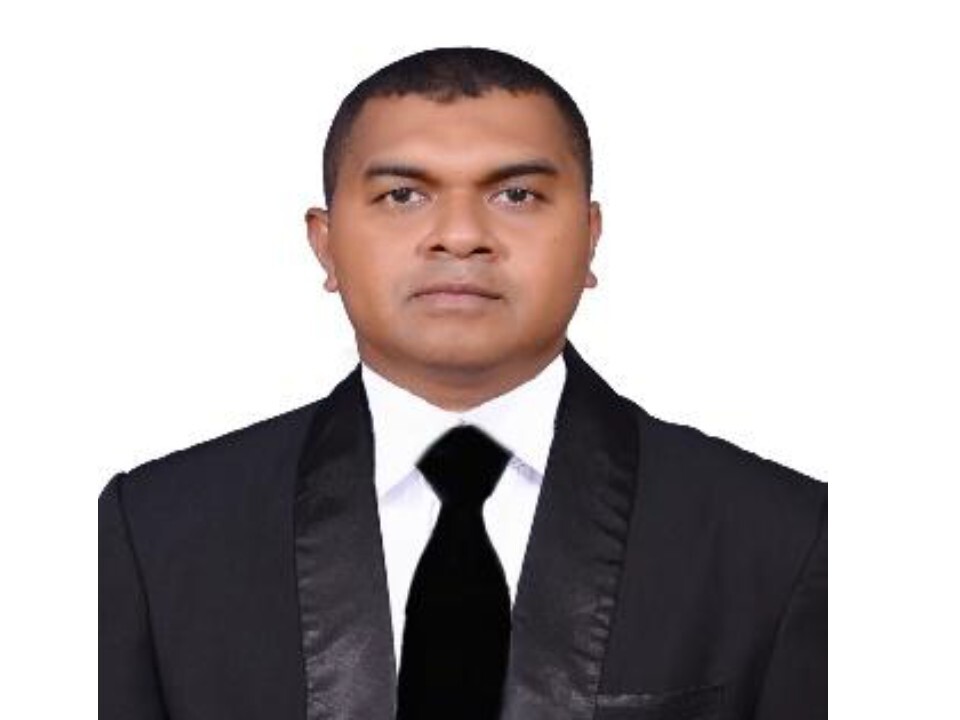
Andri T. Rachmadi, Ph.D

    In2Bio3 Senior Scientist
Environmental Health & Engineering
Senior Scientist at Institute of Environmental Science and Research (ESR), New Zealand

Doctor in Environmental Engineering, Hokkaido University, Japan (2018)

‪Andri Taruna Rachmadi‬ - ‪Google Scholar‬

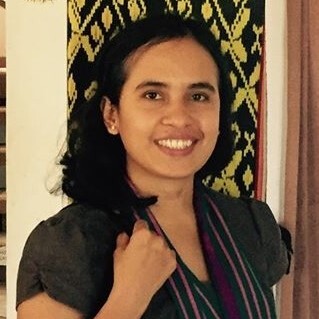
Ariyanti S. Dewi, Ph.D

In2Bio3 Senior Scientist

Bioorganic Chemistry

Senior Researcher at National Research and Innovation Agency (BRIN), Indonesia

Doctor in Chemistry, The University of Queensland, Australia (2017)

Ariyanti Suswita Dewi‬ - ‪Google Scholar‬

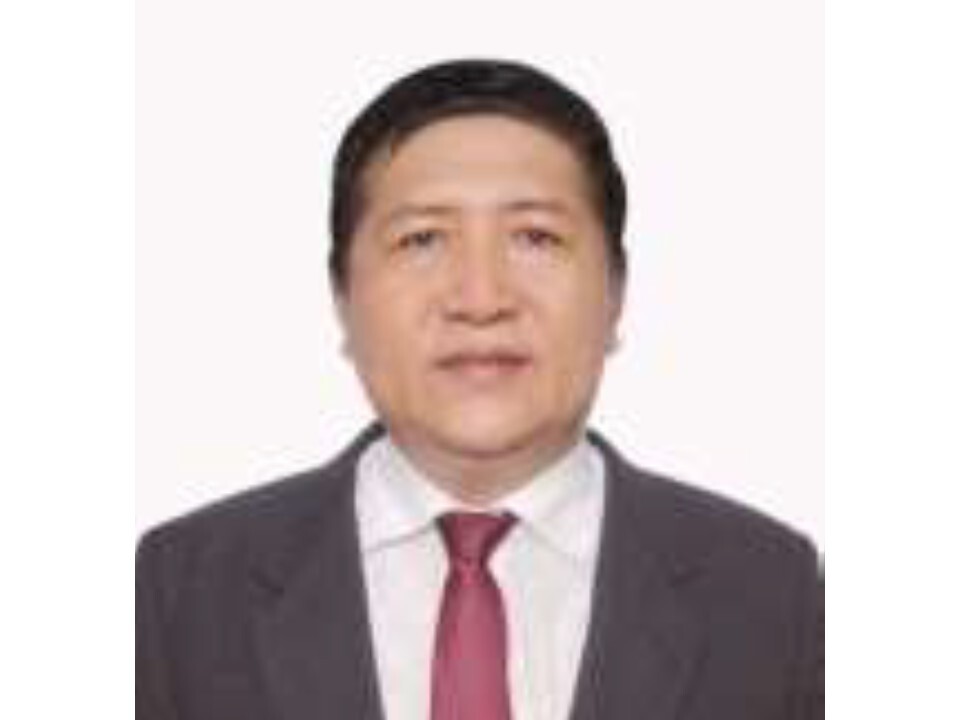
Eric R. O. Siwu, Ph.D

In2Bio3 Principal Scientist

Bioorganic Chemistry

Former Assistant Professor at

Osaka University, Japan (2010-2014)

Doctor in Organic Chemistry, Nagoya University, Japan (2007)

Eric Richard Oktavianus Siwu -ResearchGate

Prof. Inneke F. M. Rumengan, Ph.D

In2Bio3 Principal Scientist

Genetics and Bioecology

Professor at Sam Ratulangi University

Doctor in Marine Science & Coastal Engineering, Nagasaki University, Japan (1990)

‪Inneke Fenny M. Rumengan‬ - ‪Google Scholar‬

W. Donald R. Pokatong, Ph.D

In2Bio3 Senior Scientist

Nutraceutical & Food Biotechnology

Senior Lecturer at

Pelita Harapan University (UPH)

Doctor in Plant Molecular Biology & Protein Biochemistry, National Research Council of Canada (2001)

‪W. Donald R. Pokatong‬ - ‪Google Scholar‬

Dr. Syahrul Aminullah

In2Bio3 Senior Scientist

Blue Bioeconomy

Public Policy Specialist at National Research and Innovation Agency (BRIN)

Doctor in Public Policy Administration, University of Indonesia (2015)

Satria A. Kautsar, Ph.D

In2Bio3 Senior Scientist

Bioinformatics, AI, & Biogeography

Senior Scientist at A*STAR Singapore

Doctor in Bioinformatics, Wageningen University, The Netherlands (2021)

‪Satria Ardhe Kautsar‬ - ‪Google Scholar‬

Dr. -Ing. Jonatan A. Lassa

     In2Bio3 Principal Scientist
Climate Change & Disaster Management 

Senior Scientist at Earth Sciences, NZ
Doctor in Disaster Risk Governance, The University of Bonn, Germany (2010)
 
Jonatan Anderias Lassa‬ - ‪Google Scholar‬

Astri D. Tagueha, M.Sc

In2Bio3 Scientist

Environmental Health & Engineering

Lecturer at Pattimura University

Doctoral student in Clinical Microbiology, Sapienza University of Rome, Italy (ongoing)

‪Astri Dwyanti Tagueha‬ - ‪Google Scholar

Adhi Susilo, Ph.D

In2Bio3 Senior Scientist

Bioinformatics, AI, & Biogeography

Former Programmer at Bedford Institute of Oceanography, Canada

Doctor in Engineering Mathematics, Dalhousie University, Canada (2010)

Adhi Susilo's research works

Gratia D. Manuputty, M.Si

In2Bio3 Scientist

Genetics and Bioecology

Lecturer at Pattimura University

Doctoral student in Animal Ecology, Hokkaido University, Japan (ongoing)

Gratia Dolores Manuputty‬ - ‪Google Scholar

Dr. Dewi S. Zilda

In2Bio3 Principal Scientist

Nutraceutical & Food Biotechnology

Principal Researcher at National Research and Innovation Agency (BRIN)

Doctor in Biotechnology, Gadjah Mada University, Indonesia (2014)

‪Dewi Seswita Zilda‬ - ‪Google Scholar‬

Soleman Imbiri, Ph.D

In2Bio3 Scientist

Biobusiness & Bioentrepreneurship

Lecturer at University of Papua

Doctor in Project Management, University of South Australia, Australia, (2025)

‪Soleman Imbiri‬ - ‪Google Scholar

Tedy A. Matheos, M.M

     In2Bio3 Scientist
Blue Bioeconomy

Director at PT. Nisshinkan Indonesia

Doctoral student, University of Indonesia, (ongoing)

Fainmarinat S. Inabuy, Ph.D 

In2Bio3 Senior Scientist

Multi-Omics and Synthetic Biology

Lecturer at Udayana University

Doctor in Molecular Plant Science & Natural Product Biochemistry, Washington State University, USA (2017)

Fainmarinat Seviani Inabuy‬ - ‪Google Scholar

Olva F. Ngelo, A.Md

In2Bio3 Treasurer

Corporate Secretary at ZEF Energi

Diploma 3 in Secretarial Studies at Indonesian Adventist University (1992)

Darmawanto Uria, M.Si

In2Bio3 Scientist

Biobusiness & Bioentrepreneurship

Lecturer at University of Papua

Master in Agribusiness, Hasanuddin University, Indonesia (2015)

‪Darmawanto Uria‬ - ‪Google Scholar‬

Dr. Yulius P. K. Suni

In2Bio3 Scientist

Climate Change & Disaster Management 

Lecturer at Widya Mandira Kupang University

Doctor in Hydrology and Disaster Mitigation, Gadjah Mada University, Indonesia (2024)

Yulius P. K. Suni‬ - ‪Google Scholar

Free Chlorine put selective pressure on Norovirus

Human noroviruses are excreted in feces from infected individuals and included in wastewater. It is critical to remove/inactivate them in wastewater treatment processes, particularly in the disinfection step, before release to aquatic environments. However, the high mutation rates of human noroviruses raise concerns about the emergence of strains that are less susceptible to disinfectants and can survive even after wastewater treatment. 

Modules

Bioinformatics

Get in Touch with Us

‌We are open to collaborations and partnerships in research, education, and community services. 

Please contact us at in2bio3.foundation@gmail.com